
Lock the feed bin. Each delivery gets its own unlock code.
An offline electronic latch that locks the lid of your feed bins. The portal issues one code per delivery; the driver types it on the keypad and the latch unlocks. No keys, and the latch itself needs no cell signal.

An unlocked lid is an open door.
Feed mills and growers already know what these problems cost. What has been missing is a way to control and document them.
Unauthorized access
An unlocked lid is an open door: anyone with access, anytime.
Wrong feed, wrong bin
Any driver can open any bin. Nothing on the bin today ties the load to the order it was sent for.
Outbreak exposure
A driver who hauled from a sick farm yesterday can be at a biosecure bin today, and nobody has an up-to-date record of the exposure.
No record
No way to show who was authorized at a bin, or when, or whether the lid was shut afterward. That is exactly what a biosecurity audit asks for.
Six steps to a delivery on the record.
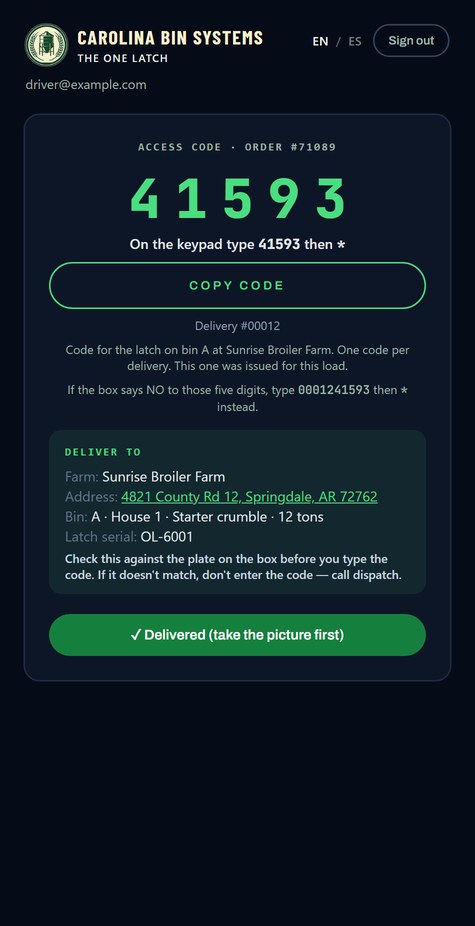
A new code for every delivery. The latch checks it right there on the bin: no server to call, no clock to keep right.
Activate the latch
Activate the latch in the portal by the serial on its plate. Every load gets a new code from then on.
Look up the order
Dispatch or the driver types the load's order number into the portal. The portal gives back the code for that delivery.
Driver enters the code
At the bin, the driver types the code from the portal on the keypad.
Latch checks it, offline
The latch validates the code itself. No Wi-Fi, no cell signal needed.No signal
The latch unlocks
A code for that latch box, or the owner's PIN, unlocks the latch so the lid can be opened and closed. A delivery code works only on the bin it was issued for.
Close the lid, photograph the latch
After the fill, the driver closes the lid, locks the latch with one press of the star key, and photographs the closed latch in the driver app. That is how the driver finishes the load: the portal's AI reads the photo and marks the delivery “lid closed” or “needs checking”, and the picture stays on the record, one click away for a person to confirm. A driver can't finish a load without it. The latch does not report lid openings, so the photo is the record.
The code that approves the load is the code that unlocks the bin.
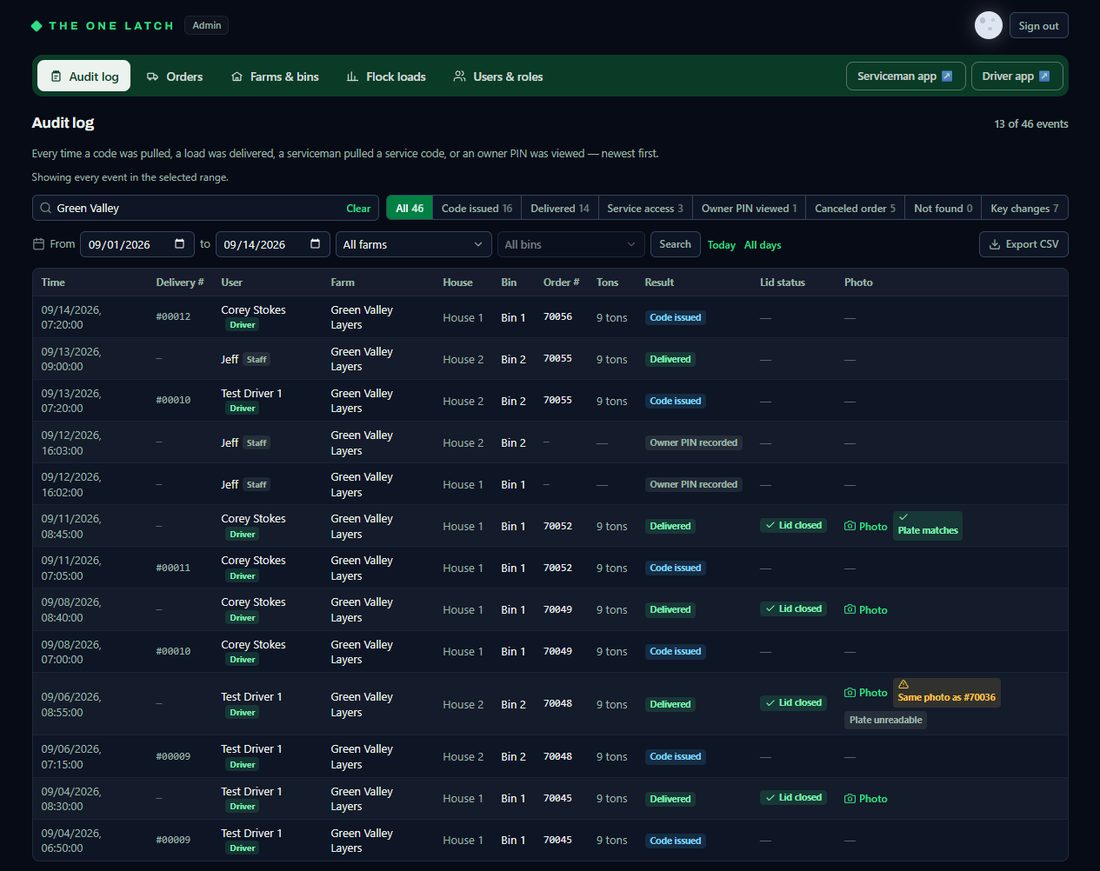
Every code, and every closed-latch photo, is logged.
The portal records which bin, which load, who pulled the code, and when. The latch itself stays offline. The record is every code the portal issued and every delivery the driver closed with a photo, and a manager can open it any time.
The box on the bin's leg.
3D-printed today, with injection molding planned for volume. Farm equipment that fails in the mud does not get bought twice, so here is what failed on ours: the unit we put on a feed bin as a weather test ran 26 days and failed by day 31 with a flat battery. We had not set its solar charge controller for a lithium battery. That is set now, the battery is replaced, and the unit is back on a bin. Why the battery ran down in the first place is not measured yet, so we do not quote a run time.
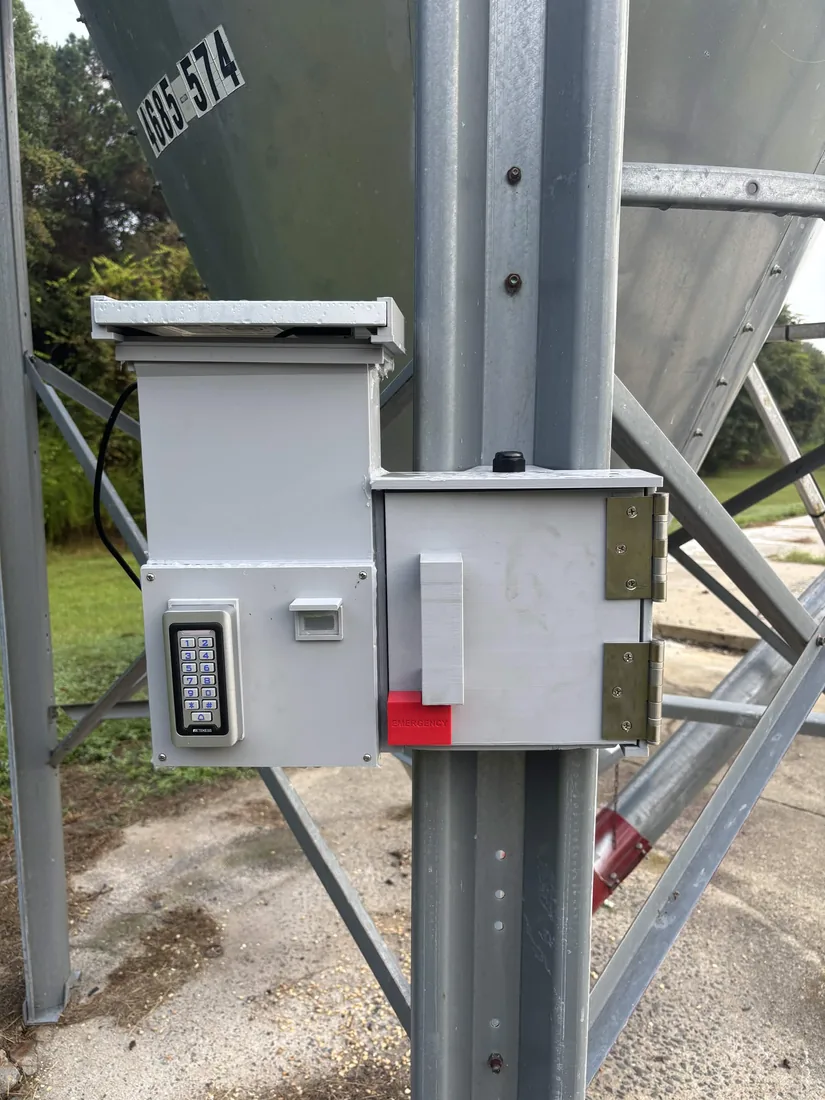
A saddle bolted through the bin's channel leg: six holes drilled on install, deburred and cold-galvanized. The bin body itself is untouched.
Type the code and the deadbolt releases. The display shows the driver every digit as it is entered.
IP68-rated keypad on an enclosure built to be sealed. Production target IP65/67, UV-stable material.
A small solar panel, a charge controller and a 12 V LiFePO4 battery.
The owner's PIN, set on the box, unlocks the latch without a delivery code, for the farm owner or a serviceman. If the keypad or the battery is down, a mechanical release on the box unlocks the latch with no power and no code.
The code is tied to the delivery, not the date. The latch is designed to check it with no clock, so there is no clock to set or keep right for the unlock.
Built by people who deliver feed for a living.
The One Latch was designed and built in eastern North Carolina, and the next run is being built. Patent-pending.
Booth B6060
Let's prove it on a few bins.
Pick any farm or bins you want to test, with real loads, over a set window. We install it: it bolts to the bin's leg, and we activate it by its serial. Then we run real deliveries and review the results together.
- Feed mills, integrators, growers, and bin makers
- A walkthrough of the portal on your own bins and orders
- Pilot terms sized to your bins
Prefer to talk? Corey Stokes, 252-289-8071, coreystokes359@gmail.com